Blog

How to Avoid Startup Suicide: Indecision Startups are more likely to die from suicide than homicide.

-Paul Graham

The above quote is so powerful and so true — most companies die from self-inflicted wounds than from an external force (competition, economic downturn, etc.).

To expand upon this further, I believe there are two main types of startup suicide are: toxic founder relationships and indecision.

In my post about toxic founder relationships, I shared how we cultivate a healthy relationship among the founding team at Panacea. In this post, I’d like to dive into the perils of indecision and how it leads to startup suicide.

Indecision leads to decision-making by consensus (only making decisions when everyone agrees) and as a result, slow decision-making. This ethos is magnified at a startup because speed is a true competitive advantage that is vital for success. Indecision not only leads to slow decision-making, but also leads to fear of failure. Indecision leads it playing safe because the conservative route is the only one that everyone will agree to. Indecision among the leadership team permeates throughout the company and before you know it, you’ve created a culture that fears failure, struggles to make decisions with conviction, and plays it safe every time.

This leads to failure because a company that doesn’t move with conviction and speed will bleed talent and lose out to the competition.

As a result, it’s important for leaders to implement a decision-making framework that allows their companies to make decision with conviction and speed.

I believe there are three fears that paralyze decision-making:

  1. Fear of going against the crowd. This is the most common problem to effective decision-making. People fear going against the crowd by stating an unpopular opinion. What often happens is the entire group feels each other out and waits for a consensus to develop before anyone risks taking a position. If and when a group consensus emerges, one of the members will state it as a group opinion, not as a personal position (you’ve probably heard it phrased as “It sounds like we agree that…”). After the group opinion is shared, if the rest buy in, the position becomes reinforced and further validated by others.
  2. Fear of sounding dumb. This is a natural fear that everyone has faced at some point. Moreover, this fear often afflicts those who are highly knowledgeable and/or in positions of authority. For the senior person, this is likely to keep him from asking questions he should ask because there is the belief that he should already know the answers. This fear permeates throughout an organization because it will make others merely think their thoughts privately rather than articulate them for all to hear. Each time a question is suppressed and as a result, an insight or fact is withheld, the decision-making process is compromised because there are less data points to make an informed decision.
  3. Fear of being overruled. This is a fear that often affects junior-level people in an organization. If a manager (or the group) vetoes or opposes the position a junior person was advocating, the junior person might lose face in front of her peers. This even more than the fear of losing their job makes junior people hang back and let the more senior people make the decisions.

These fears are present in many organizations because they’re natural fears we as humans face and have to overcome. Leaders need to take proactive steps to eliminate these fears and cultivate a culture that makes decisions with conviction. Below are three core beliefs we preach and practice at Panacea:

Obligation to dissent. This is a phrase that we’ve adopted from Google. Obligation to dissent gets at the heart of true consensus-driven decision-making.

  1. Consensus is not about getting everyone to agree. Instead it’s about coming to the best idea for the company and rallying behind it.
  2. Reaching this best idea requires conflict. People need to disagree (it’s an obligation) and debate their points in an open, safe environment where opposing viewpoints are welcome.
  3. The right decision is the best decision, not the lowest common denominator decision upon which everyone agrees.
  4. The people closest to the decision are the best equipped to make that decision. Regardless of position or authority, there needs to be an emphasis placed on empowering those who are closest to the decision. There needs to be buy-in from the highest levels of an organization to trust those who are closest to the decision-making process. This doesn’t mean blind trust — there needs to be effective checks and balances (thus reinforcing the obligation to dissent and debate opposing viewpoints).

Decision-making hygiene. There are six assumptions that must be in place for effective decision-making. By answering the following questions, the chances of politics entering the decision-making process are minimized:

  • What decisions need to be made?
  • When does it need to be made?
  • Who will decide? An “obligation to dissent” approach only works if it is managed by a single decision-maker who owns the deadline and will break a tie. There is a point at which more analysis and debate won’t lead to a better decision. This is the most important duty of the decision-maker: Set a deadline, run the process, and then enforce the deadline.
  • Who will need to be consulted prior to making the decision?
  • Who will ratify or veto the decision?
  • Who will need to be informed of the decision?

Social capital. Social capital is the human currency we have with other people. Like money, social capital is finite and earned. Unlike money, social capital has a ceiling — there’s only so much social capital one can have with another person.

To create a culture that makes decisions with conviction and speed, decision-making needs to be decentralized. This is a pretty straightforward concept — if all decisions must be made by a single person or at the executive level, there is a bottleneck effect that slows down the decision-making process.

Decentralized decision-making relies on empowering those closest to the decision to make the decision. To cultivate this type of culture, leaders must pay attention to social capital and be mindful of when to step in and take action.

Every time a manager steps in and overrules a junior person who makes a recommendation (because the junior person is closer to the decision), the manager burns some social capital with that junior person. If she isn’t careful, the manager will burn all their social capital with that person and effectively lose the junior person’s trust.

Once trust is eroded, morale and commitment dies because the junior person sees no point of putting in the work because he knows his manager is going to overstep and make the decision regardless of his recommendation.

At Panacea, we use a 2×2 Impact/Conviction grid to determine when to step in and when to trust the person closest to the decision-making. The 2×2 Impact/Conviction grid is a powerful tool that needs its own dedicated post (maybe the next one?).

In summary, it is a framework to weigh the level of impact of the decision at hand and the level of conviction that a leader has to determine whether that leader should empower the junior person to make the decision or overstep and make the decision that goes against the junior person’s recommendation.
Top Finds #35

by Phillipe Laval

Lessons From a Top FBI Hostage Negotiator Last week, I wrote that I was seriously downsizing my material possessions. That means a lot of items to sell via second-hand websites. And facing shrewd negotiators, determined to peel off every possible euro. Great timing, I bumped into a podcast, with the ultimate negotiator. He worked with the FBI for 24 years, as lead international negotiator. Saved thousands of lives. He shares his secrets with James Altucher in Chis Voss: This Is What I Do In A Negotiation. Loved it ! His techniques are quite counterintuitive. And very effective – I’ve started testing them ! His focus is on emotions. Making the other person solve the problems for you in a way that makes both parties happy. My favourite techniques include: 1. “How“. When you ask “how“, you get them to solve your problems for you and in a way they deem acceptable. If a kidnapper demands $1 million cash in 12 hours, a question like “how am I supposed to do that ? ” allows you to say no without alienating them. 2. “No“. When I get a cold sales call it often starts with “yes-trap” questions like “Do you have a phone subscription ?” (obviously…) Just to get me to say yes and start taking me through the sales funnel. So when we get a “yes” question we feel manipulated. Voss recommends we instead get them to say “no” first. Then they can relax. For example at a book signing he asked cold the ex GE CEO Jack Welsh “Is it a ridiculous idea for you to come and speak to the course I teach at USC ?” 3. “List the Negatives“. A great way to create empathy and defuse the negative. You proactively do your “accusation audit“. You may say things like “I know you probably don’t trust me” or “I know it seems I don’t care about you“.  4. “Mirror“. Whatever they say, repeat their last words. As much as possible. I gave it a test on the second-hand website. He said “I can take it for 30 but not above“. So I just repeated “you can take it for 30 but not above…” and he volunteered more information which allowed me to reposition the whole exchange.  5. “Who throws out a number first ?“. Classic negotiation books like Getting to Yes advocate you should give the first number, for anchoring. Voss says let them come up with the first number. And if in a salary negotiation the number is too low, you can get back to the other techniques. Like “if everyone else in my industry is paid ‘X’ then how can I go with the number you suggest ?”  6. “Powerless“. When you arrive at a stage where you feel the negotiation is not going your way you can tell them “sounds like there is nothing YOU can do“. As Voss says, “this will make them feel powerless. Nobody wants to feel powerless. They will say no to that and now they will try to do something for you to prove they are not powerless“. Voss offers many other great techniques like “Use specific numbers“, “Late Night FM DJ Voice“, “Terms and Conditions“, etc. Tune it to the podcast to discover them, along with other fascinating anecdotes. Personal message to my girls: this one you can skip, you already have too much of the upper hand (-;          What to Say if a Conversation Turns Negative While reading this great short HBR article, I had a flashback of previous disastrous conversations that could have been turned around. It sounds simple. First not to victimise ourselves. We’re responsible for how others treat us – with what we do/don’t do or say/don’t say. Next, it’s important not to be stuck on an initial interpretation of a statement. Maybe what we perceived as an insult, wasn’t one or meant to be one. Finally there is more than one way to respond to difficult conversations as outlined in 7 Things to Say When a Conversation Turns Negative. The “7 Re”: Reframe/ Rephrase/ Revisit/ Restate/ Request / Rebalance/ Reorganize. For example, I feel I could use more often “Restate” to clarify or redirect negative wording. By restating with a question like “did you mean what I think I heard ?” you give the other person a chance to reconsider, a chance to do the right thing. The more techniques you can draw upon, the more unpredictable you will become. And therefore less of a target to those who might want to drag you into difficult conversations (-: Great Books Summarised in Three Sentences Looking for a list of great Smarter, Wiser, Happier books ? I like the selection of James Clear. And Book Summaries: Popular Books Summarized in 3 Sentences or Less is not just a list. With each book, a short summary. For example, for Free Will by Sam Harris: “We do not have the freedom and free will that we think we do. Yes, you can make conscious choices, but everything that makes up those conscious choices (your thoughts, your wants, your desires) is determined by prior causes outside your control. Just because you can do what you want does not mean you have free will because you are not choosing what you want in the first place”. And if you want more, with each book comes an extended summary with key content and top quotes. My top recommendation for book summaries remains Blinkist (cf WTF #18), a truly great App.   What Do I Want ?” is Not the Real Question  Guilty. I ask myself too often “what do I want ?“. Thinking it is the hardest question. Not according to Mark Manson in You probably know to ask yourself, “What do I want?” Here’s a way better question. When it comes down to the goal, the good things we want in life, we’re all pretty much the same. What really makes you you, is “what is the pain that you want to sustain ?“. It’s easy to dream of becoming a rock star, a successful entrepreneur or a top tennis player. To make it true, you have to want the struggle as much as the reward, the process as much as the result. The quality of your life is not determined by the quality of your positive experiences but by the quality of your negative experiences. If you’re not making progress on your dream, that may be an indication that what you want is just a fantasy. That maybe you just enjoy wanting but actually you don’t want it at all. I know many people in that trap, so maybe I’m doing the same. There are areas where I’m eager to deal with the pain (like improving running times in a 20k) and others that I consider more important, yet in which I don’t put the same level of struggle… Super inspiring !   Qwant – A Respectful Alternative to Google  I love the convenience and effectiveness of Google. But there is a price to pay. I’m contributing to building one of the world’s largest monopolies. I’m giving away a lot of private information. Potentially not just to Google… And perhaps more insidious, there is the “filter bubble”. That means the more Google knows me, the more it restricts search results to fit my preferences and beliefs. No quite the spirit of WTF… I’m testing an alternative, Qwant. It’s France-based, so any data stays in Europe. They guarantee 100% privacy protection and don’t do filter bubble. My early user experience is a bit akin to shopping in an organic groceries store (-; They have something close enough to what you are looking for but in a rougher format than your regular supermarket. I think I can make it work, though. If you have kids you may also be interested in Qwant Junior for a “clean” web experience. If you’re enjoying my Top Finds, do not hesitate to forward this to friends and suggest they sign up for the weekly dose. Also do not hesitate to share your suggestions. You can access prior issues here.

The Mindful Way to Ultimate Productivity

Benjamin Foley is the founder of Fully Rich Life

“Perfection is achieved not when there is nothing more to add, but when there is nothing left to take away.” — Antoine de Saint- Exupery

“Either you run your day or your day runs you.” — Jim Rohn

Perfectionism is procrastination.

One of the biggest lies I constantly tell myself is that I don’t have enough time in the day to complete the things that I want to complete. When I say that I am ’too busy’ to do the things that are most important to me I am falling victim to lazy thinking.


Even with the quantum leaps in technology that our generation has been so lucky to witness, we are still constantly overwhelmed by all we have to do. The answer to the problem is not to add more things (technology). The answer is in the disciplined pursuit of less.

Time is the most precious commodity we are all given. It is the only non-renewable resource we have. You can always make more money, but you can never make more time. Thus, it is vital that we become masters of our day.

We must view our day like a hedge funder manager views his portfolio. Allocating our assets (hours) effectively in order to realize the greatest return. Although the disciplined pursuit of less is one that never ends, I have learned a trick or two that helps me keep my priorities in order and allows me to create space for the beauty the world has to offer.

Step 1: Hell Yeah, or No!

My current productivity mantra comes from Derek Sivers (founder of CD Baby; sold for $22 million) who uses a counter-intuitive framework when determining to pursue a task or not. “If it’s not a ‘Hell yeah!’ it should be a No.” Contrary to popular belief, saying yes to everything when you are a young professional is NOT the way to get ahead. Instead, saying yes to the few critical things that matter the most to you and going all in on them is. To quote Derek,

Those of you who often over-commit or feel too scattered may appreciate a new philosophy I’m trying: If I’m not saying “HELL YEAH!” about something, then I say no.

Meaning: When deciding whether to commit to something, if I feel anything less than “Wow! That would be amazing! Absolutely! Hell yeah!” then my answer is no. When you say no to most things, you leave room in your life to really throw yourself completely into that rare thing that makes you say “HELL YEAH!”

We’re all busy. We’ve all taken on too much. Saying yes to less is the way out.

So the next time you feel “obligated” to go to the company happy hour ask yourself these 2 questions:

  1. Is this activity moving me towards my goal?
  2. Will this activity bring me joy?

If the task or activity will move you closer to your goal or it is something that will bring you joy, do it.

If not, politely decline.

Although you may lose a couple friends in the process, you will gain a deeper connection with those that matter.

Step 2: Eat the Frog

If it’s your job to eat a frog, it’s best to do it first thing in the morning. And if it’s your job to eat two frogs, it’s best to eat the biggest one first.” — Mark Twain

The phrase ‘eat the frog,’ comes from the notion that doing the most important and difficult task on your plate first thing in the morning makes the rest of the day seem like a cakewalk in comparison.

So, every morning (or night), write out the 3–5 most important tasks for the day that will move you closer to your goal. Prioritize them. Then make a disciplined commitment to focus on completing each individual task before moving on to the next one. If you do not finish all of your MITs, move them to the top of the list for tomorrow.

No…your MITs will never be to update your business cards, do your dry cleaning, or clean your inbox.

Cal Newport, in his book Deep Work, defines this process as is the ability to focus without distraction on a single, cognitively demanding task until completion. It’s a skill that allows you to quickly master complicated information and produce better results in less time.

We have limited time and resources (both mental and physical), so it is vital to first focus on the most important tasks that have the biggest impact before we get pulled away by the plethora of other responsibilities.

Daily Targets Assessment:

1. Which task do I have to do that is offering me the most resistance?

2. Which task will make me feel the most accomplished?

Step 3: Simplify; Be effective over being efficient

It is very important to not confuse efficiency with effectiveness. The best door-to-door salesperson in the world can be incredibly efficient, yet nowhere near as effective as a kid sitting in his boxers sending out thousands of emails. A person who checks email 30 times a day and has an elaborate system of organizing, might be incredibly efficient but is not being effective.

Before starting any task, top performers first ask what is the most effective use of my time? and then apply efficiency to that task. Doing something unimportant well does not make it important. “What you do is infinitely more important than how you do it. Efficiency is useless unless applied to the right things.” — Tim Ferriss

The first rule of any technology used in a business is that automation applied to an efficient operation will magnify the efficiency. The second is that automation applied to an inefficient operation will magnify the inefficiency.” — Bill Gates

Questions to Ask:

1. Am I being effective or just active?

2. 80/20 Principle: What are the 20% of tasks that lead to 80% of my desired outcome. Focus on those and eliminate the rest

3. If this was easy, how would it look?

4. If I could only work for 3 hours a day, how would I get it done?

5. Is this task necessary to the completion of the project?

Resources:

1. Four Hour Workweek — Tim Ferriss

2. Effective Executive — Peter Drucker

Step 4: Focused Health

Your mental and physical health are critical to your ability to be productive. Remember the 80/20 principle here. There is no need to be perfect but any step closer to a fully optimized mind and body will only multiply your effectiveness. As Ben Franklin said, “early to bed (consistent sleep), early to rise (effective morning routine), makes a man healthy (body), wealthy ($$$), and wise (mind).”

1. Consistent Sleep

This post is not meant to go into the science of sleep habits (if interested, go here), but your productivity is directly correlated with the amount of sleep you get. I aim for 7–8 hours, but I know some people who can get 6 and be fine. The point is to figure out the amount that allows you to operate at the highest level.

2. Morning Routine

How you spend the first hour of your morning can set your day up to be a work of art or one of chaos. It is not always possible to plan the middle of your day, but you can always make a choice about how to spend your morning.

Here are the 10 things I do every morning to decrease my anxiety.

“A daily routine built on good habits is the difference that separates the most successful amongst us from everyone else” — Darren Hardy

Step 5: Batching

Batching is the most effective way to handle the repetitive, important tasks that you have to do every week.

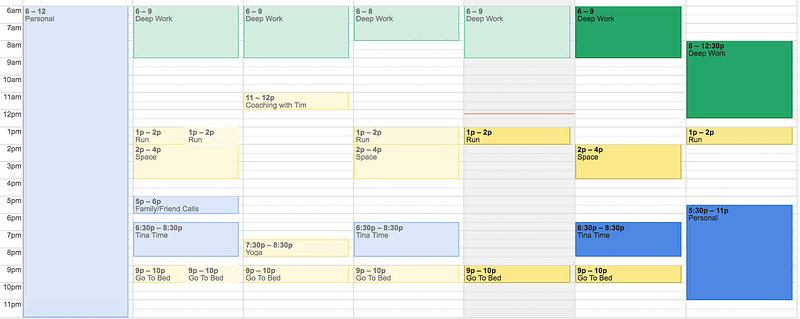
My Batching for the Week

Tasks that can be easily batched:

1. Email

  • Pick 2–3 times a day to clear your inbox; Email is the single biggest deterrent to corporate productivity. Give yourself a system and take back your time.
  • Do not use email as an instant chat

2. Laundry / Dry Cleaning

  • Pick a day that you are going to do your laundry, put it on your calendar, and do not worry about it until that day comes.

3. Exercise

The single biggest failure point when it comes to exercise is relying on motivation to get you to the gym. Willpower is weak. Put it in your calendar. Show up no matter how you feel.

4. Food Prepping

Every Sunday, my fiancé and I spend 2–3 hours prepping our lunches for the whole week. This habit saves us money by not having to eat out, mental resources by limiting decision fatigue, and time by not having to make our lunch every morning/eat out every day.

5. Studying / Learning

  • Put your study sessions on the calendar.

*You are scientifically proven to be more likely to complete a task if you put it on your calendar.

Step 6: Be a Lightswitch

In our ever-increasing pace of life, it is easy to find ourselves mindlessly moving through our days and weeks without any intentional action. Constantly bouncing between meetings, spreadsheets, and calls. Never stopping for a second to be mindful of what we are doing or why we are doing it.

In order to take your productivity (and fulfillment) to the next level, it is necessary to have the ability to turn on and turn off.

To be honest, this is one of my biggest struggles when it comes to productivity. I am constantly thinking — How can I read more? How can I learn more? Who can I reach out to in order to advance my career?

However, if you want to be more productive and achieve more in your daily routine it is vital to take the time to clear your mind in between bouts of intense focus (see Pomodoro technique).

Checking your email 10 times before you get to work is not helping you achieve more. It is taking your brain’s limited resources and focusing them on a non-important task.

Be okay with breaks and taking time away from work. Use your holidays. Take off early on a Tuesday. Do whatever you need to do to turn off every once in awhile.

It will allow you to be way more productive and effective when you are working.

I have been trying (with some failure) to take one full day off of electronics a week. This may seem extreme to some, so start with a dinner or a walk.

Realize that the present moment is all we ever have. Enjoy it. Immerse yourself in it.

Easy Mindfulness Tips:

1. Delete all Push notifications. Do you really need to know who got traded to the Cubs the moment it happens?

2. Turn your phone on airplane mode when you are at dinner, working on your MITs, and exercising

3. For the Ultra Present: Delete Instagram and Snapchat for 1 week and measure the results.

The average American will spend 4 years of their life looking at their phone. Think about that…

More Resources & Tools

I have listed a couple tools that can help below, but for the Ultimate Productivity Toolkit sign up below!

1. Evernote

This is the holy grail of organization and productivity…once you can master it. I keep everything from book notes to airplane tickets to life goals in here. Everything is searchable, even pdfs. To become a master, I suggest you buy Brett Kelly’s amazing book Evernote Essentials

2. Boomerang

Have you ever forgotten to follow up after a job interview? This will be your life saver. Boomerang is a Chrome extension that allows you to Boomerang any email to a set time in the future. I use it to keep my inbox (and brain) in order.

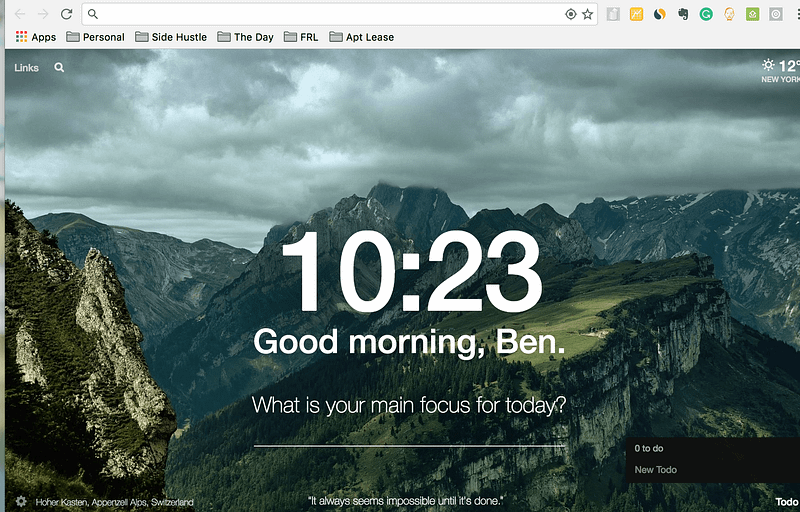
3. Momentum

  • A chrome extension that prompts you to input your most critical tasks every time you open up your browser.
  • Plus, it has a beautiful photo and an inspirational quote

4. Rescue Time

Rescue time is my accountability partner. It keeps track of what websites and programs I use and sends me a detailed report every week.

So to recap…

It is vital to our success and fulfillment that we become effective investors with our time.

Every single day we are given the same 24 assets. It is up to us to determine how to allocate them in the most effective way to achieve the results we want.

Maybe that is to be happy.

Maybe that is to make a lot of money.

It doesn’t matter so long as you know what the result you are after is and you take consistent, daily action to achieve it.